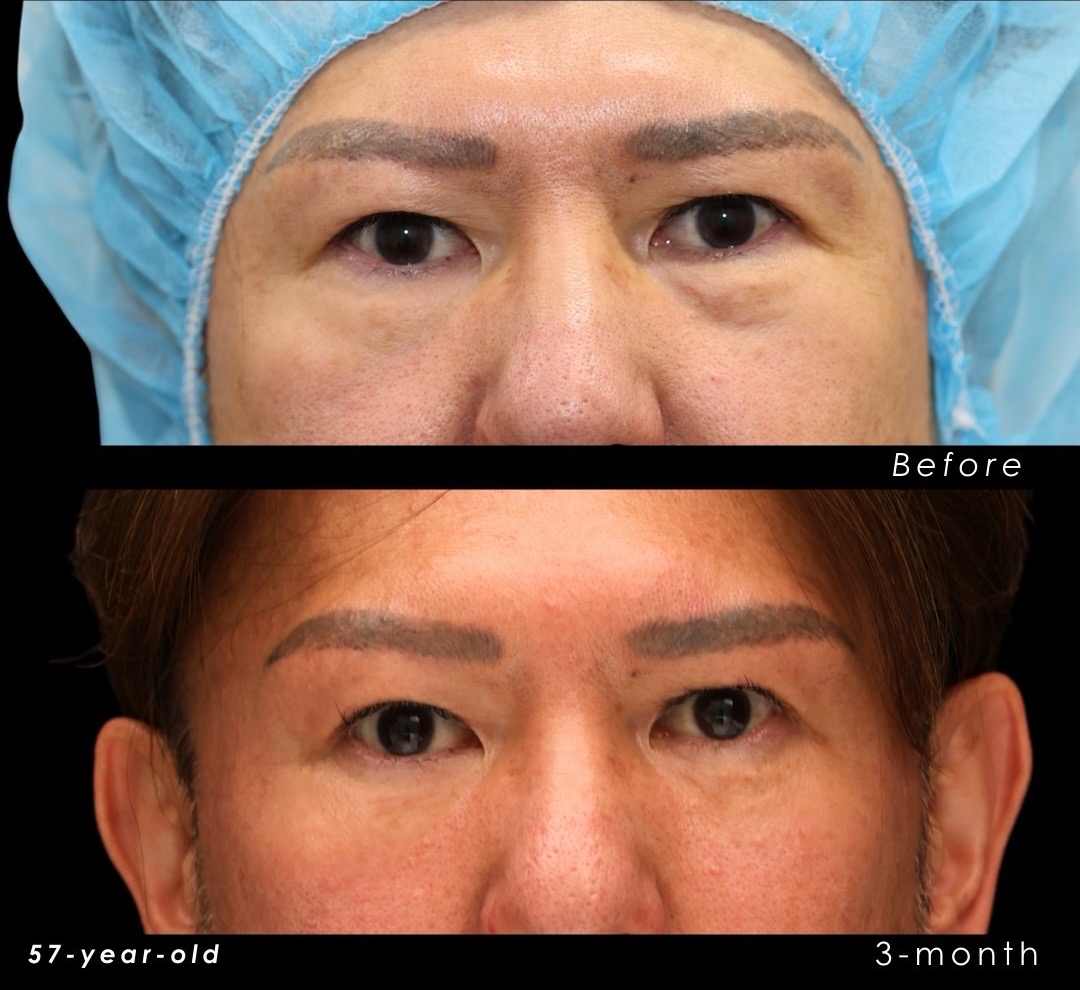
This 57-year-old man underwent treatment for under-eye bags and cheek descent. Through a transconjunctival approach behind the lower eyelid, fat protrusion and ligamentous tethering were addressed and the midface was repositioned. The frontal photographs show the change three months after surgery.
Case summary
- Age: 57 years
- Primary concerns: under-eye bags and cheek descent
- Procedure: transconjunctival midface lift
- Treatment course: one operation followed by several postoperative examinations and follow-up visits
- Photographic time points: before surgery / three months after surgery
Priorities in this case
Under-eye dark circles may be influenced not only by skin color but also by contour irregularity caused by protruding fat, ligamentous tethering and midface descent. The priority was not simply to flatten the under-eye area, but to create a natural transition from the lower eyelid into the cheek.
An ideal lower-eyelid-to-cheek transition preserves a sequence of the pretarsal fullness, a slight depression and a gentle cheek convexity. By treating the fat and ligaments together and repositioning descended midface tissue, the procedure aims to restore this continuity.
Procedure selected and its purpose
Transconjunctival midface lift
The procedure is performed through the conjunctival surface behind the lower eyelid. Under-eye fat protrusion and retaining ligaments extending from the lower eyelid into the cheek are addressed, with the aim of repositioning the midface without creating a visible skin incision.
This procedure is not suitable for every patient. Excess skin, fat position, skeletal anatomy and the degree of midface descent are assessed to determine whether skin excision or another treatment would be more appropriate.
Changes visible at three months
In the frontal view, the previously prominent boundary between the under-eye bag and cheek is softer, and the contour from the lower eyelid into the midface is smoother. Repositioning the upper cheek also makes the depression corresponding to the midcheek groove less apparent than before surgery.
At three months, swelling has generally settled and the contour is easier to assess. Tissue firmness and sensation may nevertheless continue to change. Results and recovery vary between patients, and the same degree of change cannot be guaranteed.
Treatment course and fees
- Usual treatment period and number of visits: One operation, followed by several postoperative examinations and follow-up visits. The exact number varies between patients and may also differ according to the conditions of the monitor discount.
- Total fee for the procedures shown (tax included): ¥649,000 (including anesthesia; partial-face monitor discount applied)
- Breakdown: Transconjunctival midface lift (partial-face monitor) ¥484,000 + general anesthesia with mechanical ventilation ¥165,000
*The fees shown above apply at Cinderella & Da Vinci Clinic. International patients are accepted through Your Face Clinic. Please refer to the price list for international patients (PDF) for the applicable fees.
Principal risks, adverse effects and complications
Possible risks include bleeding, hematoma, infection, swelling, bruising, pain, altered sensation, dry-eye symptoms, asymmetry, contour irregularity, entropion, double vision and a result that differs from the patient’s expectations.
Author and medical review
- Written and medically reviewed by: Shoichi Sasaki, M.D.
- Created: July 26, 2026
For detailed information about treatment, fees, principal risks and potential adverse effects, please refer to the explanation provided during your consultation.