SSSHOICHI SASAKIPLASTIC SURGEON

Treatment Guide

TreatmentsA Guide to Facial Rejuvenation Procedures

I assess facial anatomy and age-related change in three dimensions, with an emphasis on treating connected areas as a continuous unit where appropriate. The incision lines and areas of dissection shown here are representative; every surgical plan is tailored following an in-person consultation.

Results and recovery vary between patients. Your individual indications, surgical plan, downtime and fees will be explained during consultation.

01 — Face Lift

Facelift

I approach the midface and lower face as one connected anatomical unit, aiming to combine natural results with effective lifting. A deep-plane technique forms the foundation, with the surgical plan adjusted to the distribution of laxity and the condition of the tissues.

Facelift

This procedure improves laxity of the midface and lower face. The neck is addressed where necessary to prevent cervical laxity from limiting the lower-face result.

Principal risks: bleeding, infection, facial nerve injury or weakness, visible scarring, asymmetry and dissatisfaction with the aesthetic result.

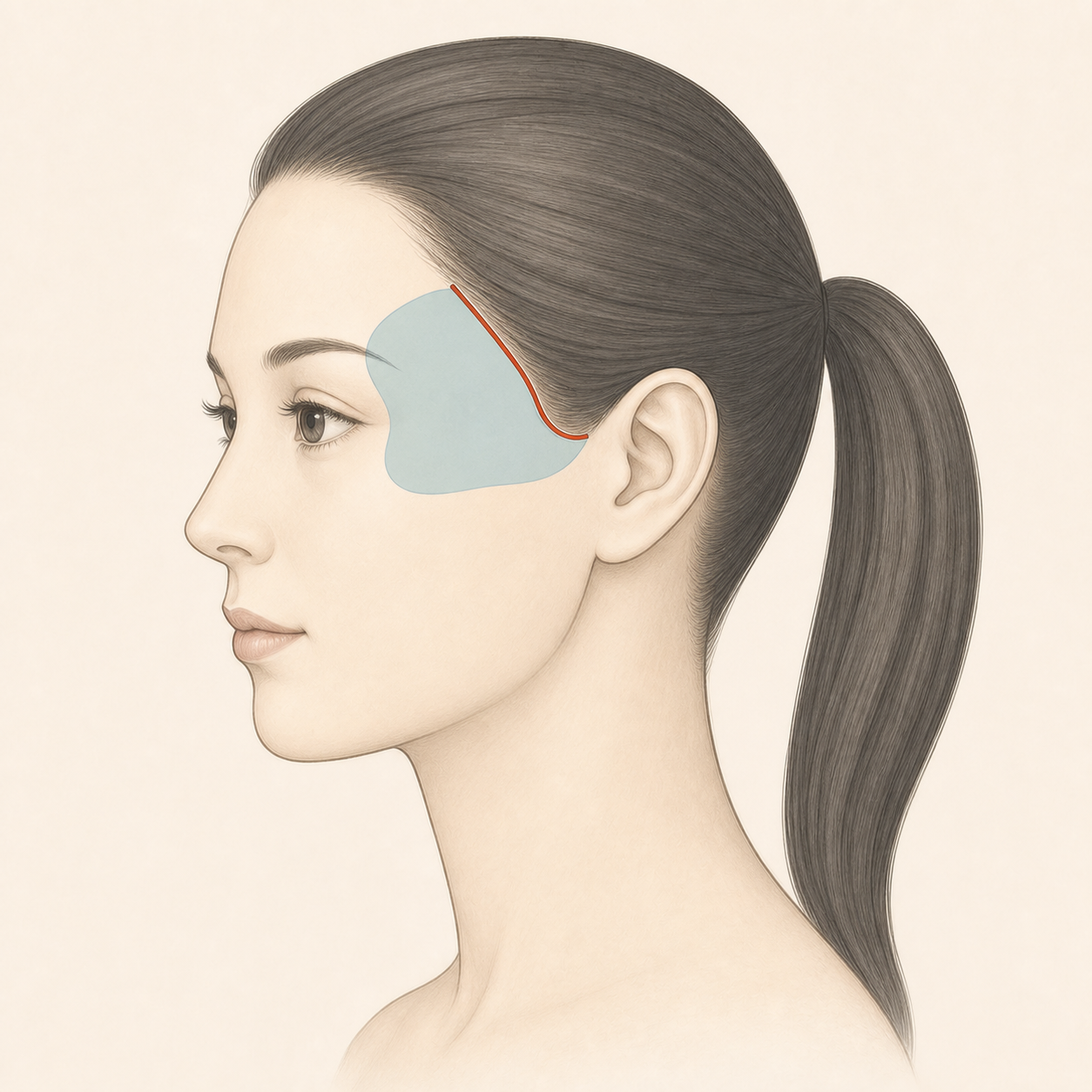
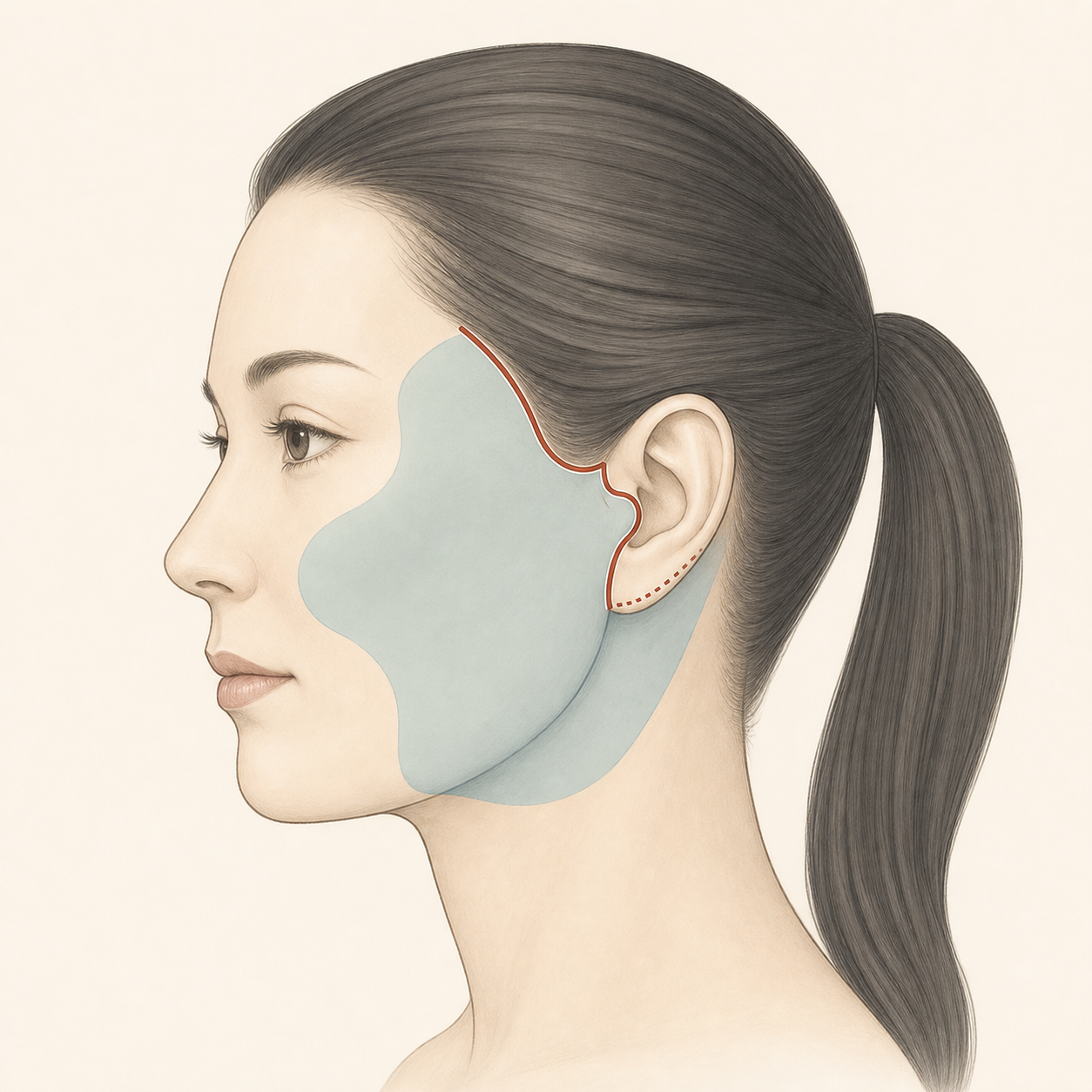
Red: incision line Blue: area of dissection
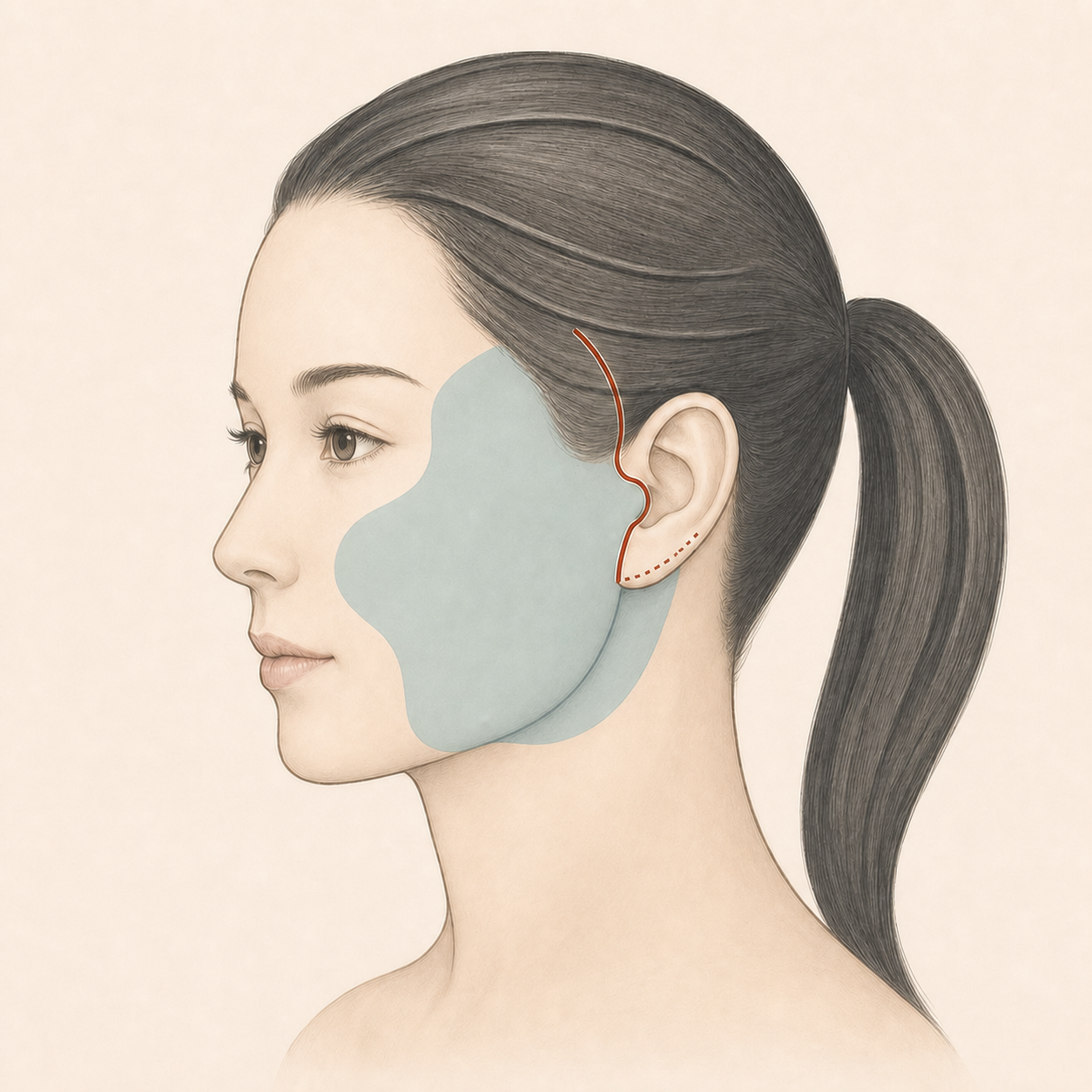
Alternative facelift incision extending within the temporal hairline
An incision placed within the hair-bearing scalp may be used in selected cases.
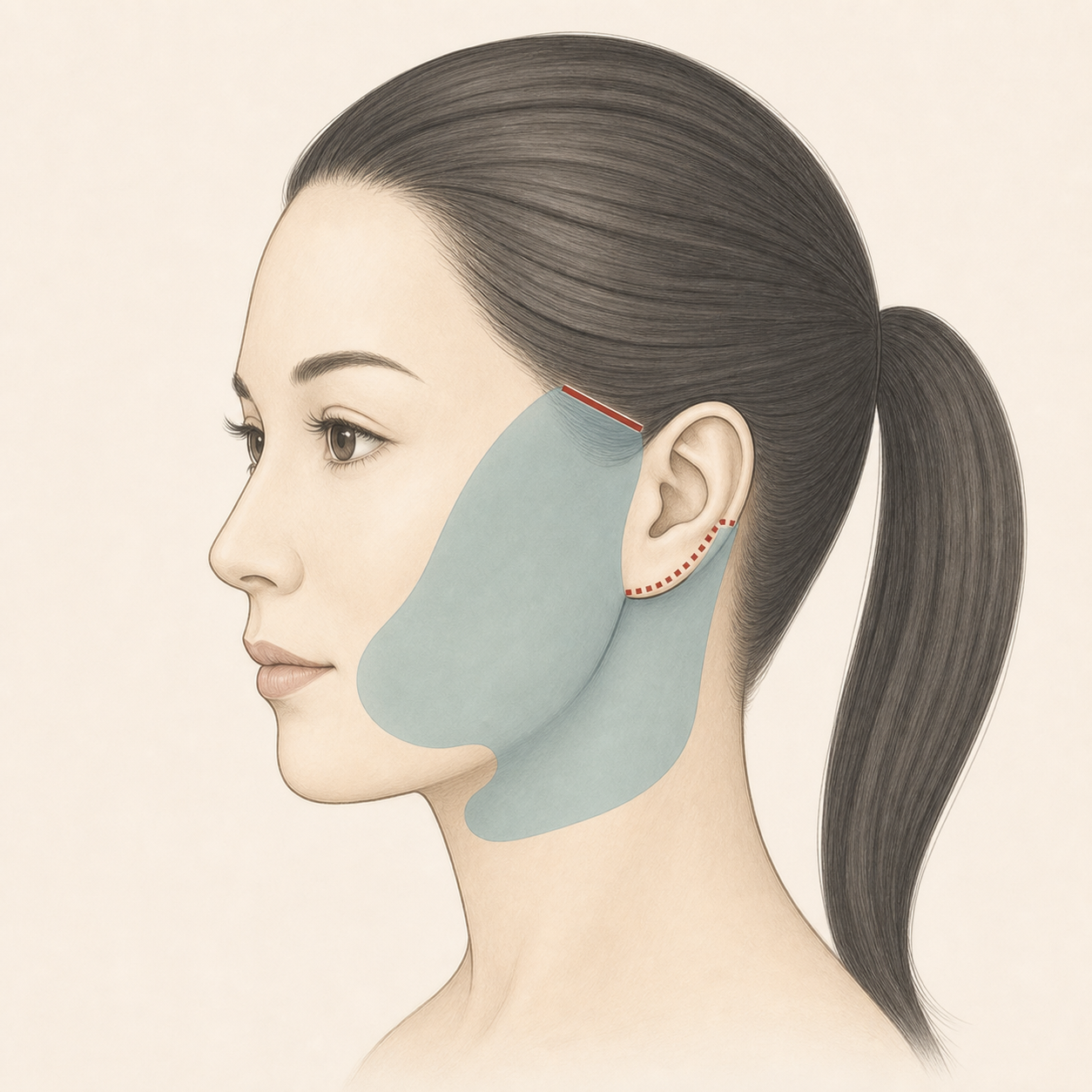
Facelift incision along the temporal hairline and the corresponding area of dissection

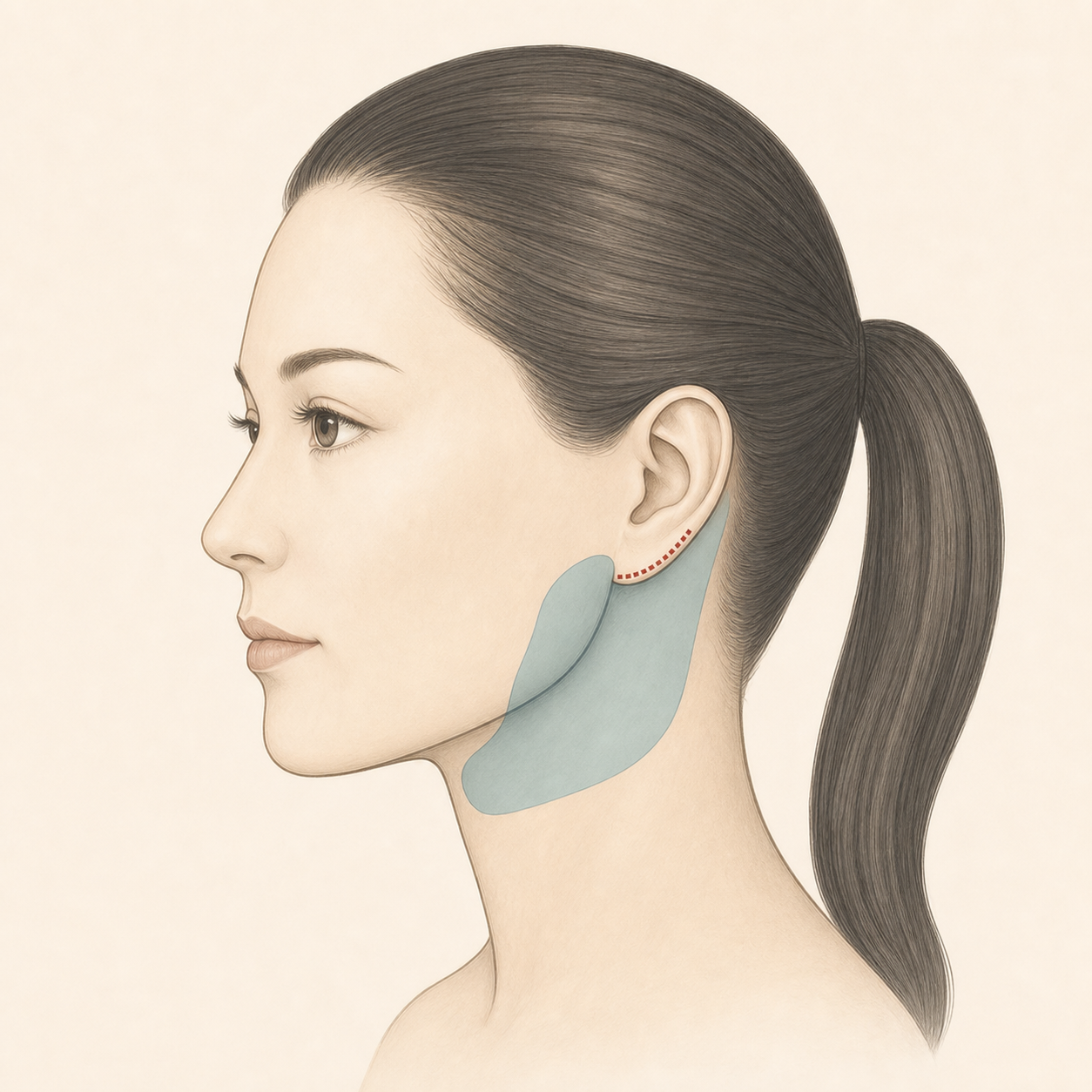
Facelift & Lateral Neck Lift

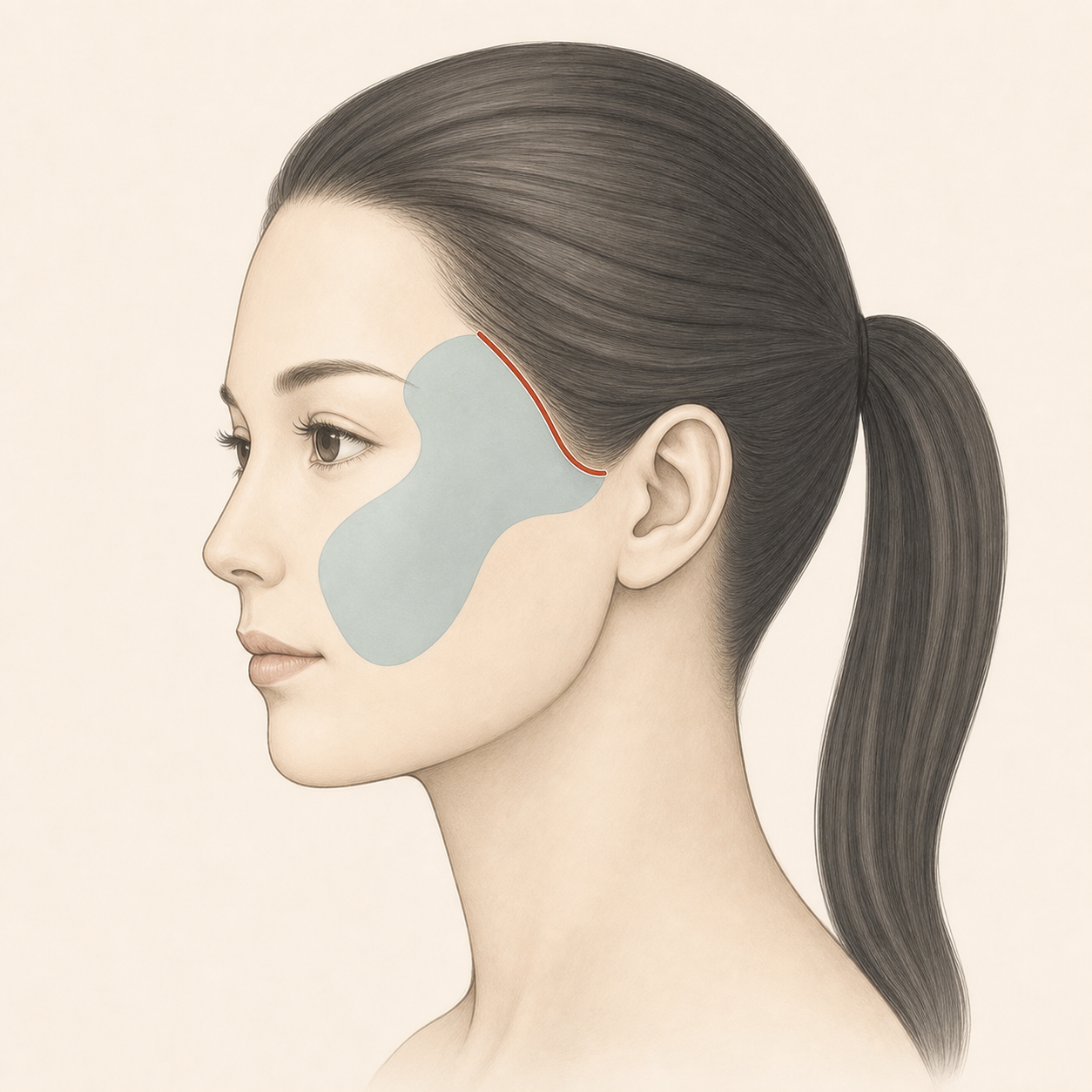
This procedure treats a continuous area extending from the midface and lower face to the lateral neck.

Principal risks: bleeding, infection, facial nerve injury or weakness, visible scarring and asymmetry.

Red: incision line Blue: area of dissection
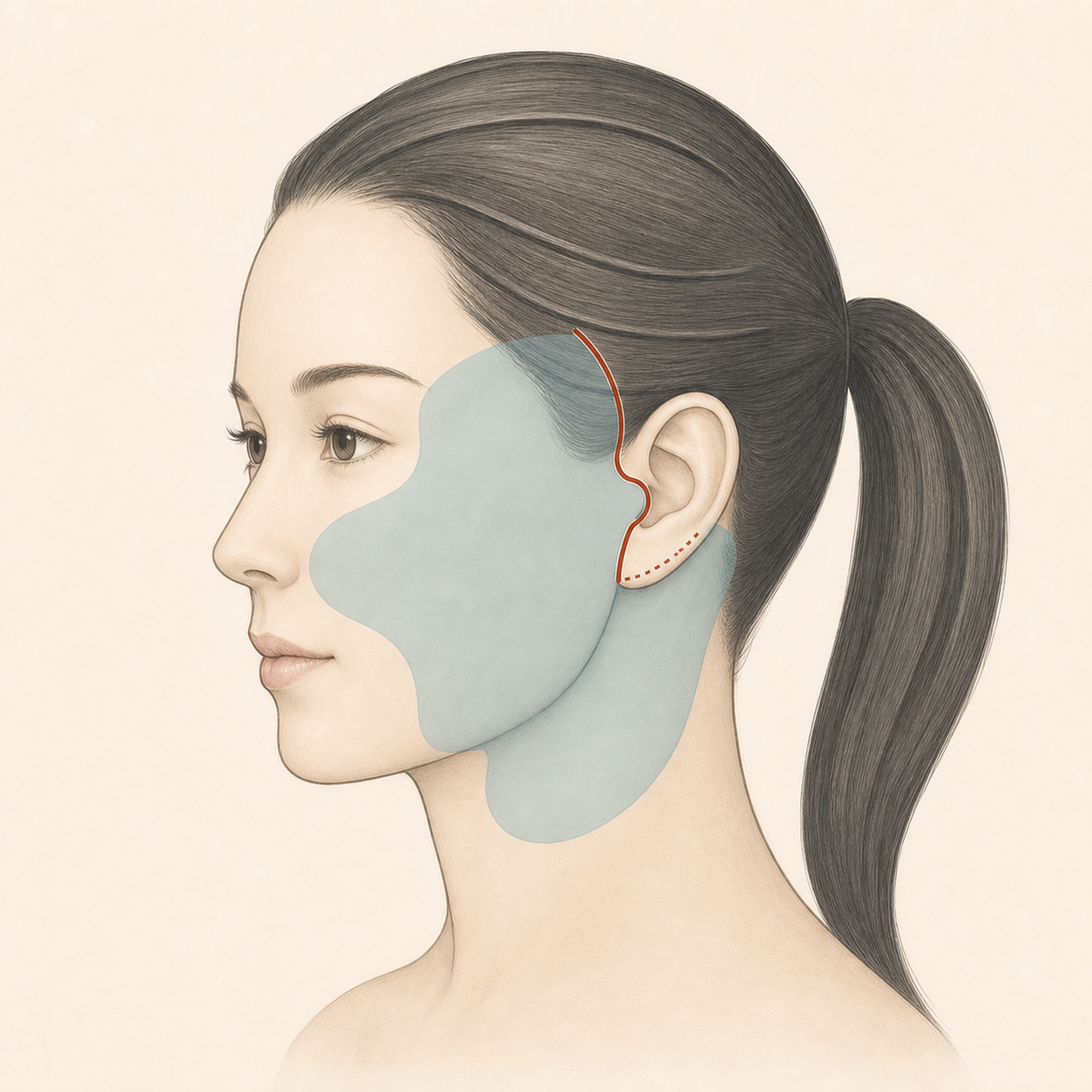
Alternative face and lateral neck lift incision extending within the temporal hairline
An incision placed within the hair-bearing scalp may be used in selected cases.
Face and lateral neck lift incision along the temporal hairline and the corresponding area of dissection

V-Line Lift

This procedure improves laxity of the lower face and lateral neck, refining the contour from the jawline into the neck.

Principal risks: bleeding, infection, facial nerve injury or weakness, visible scarring and asymmetry.

Red: incision line Blue: area of dissection
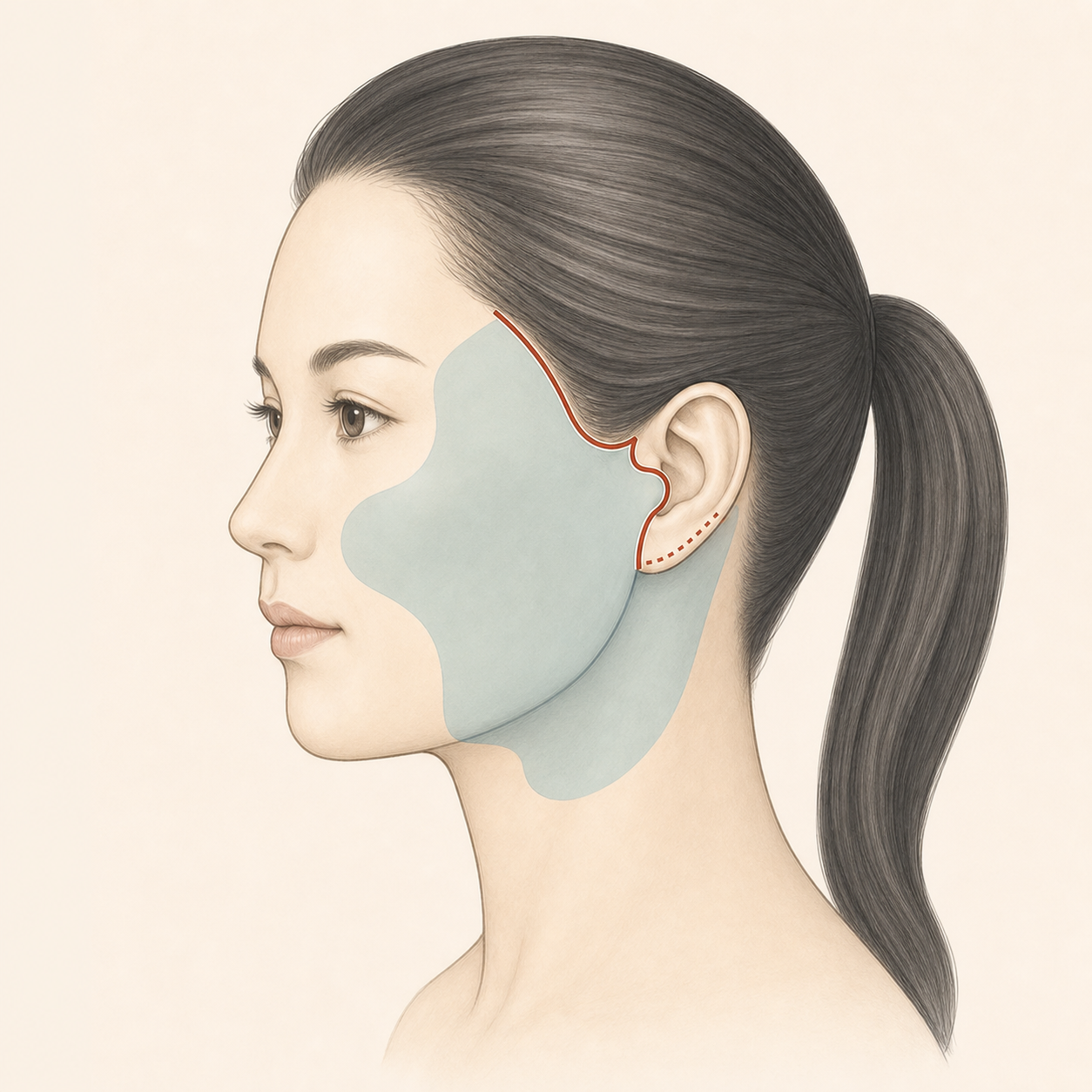
V-line lift incision and area of dissection

02 — Neck Lift

Neck Lift & Neck Contouring Surgery

Neck laxity may involve not only the lateral neck, but also central submental fat, muscle and deeper structures around the hyoid region. Procedures are combined according to the underlying cause to create a smoother contour, including the profile view.

Lateral Neck Lift

This procedure improves laxity along the lateral neck. Combination treatment with pelican surgery or a deep neck lift may also be considered.

Principal risks: bleeding, infection, facial nerve injury or weakness, visible scarring and asymmetry.

Lateral neck lift surgical illustration

Pelican Surgery (anterior platysmaplasty)

This procedure corrects central submental laxity and reduces deep fat where appropriate. Treatment around the hyoid region may be added when needed to improve the profile.

Principal risks: bleeding, infection, nerve injury, visible scarring and asymmetry.

Red: incision line (approximately 1–2 cm)
Submental incision used for pelican surgery

Deep Neck Lift

Deep submental fat and enlarged muscles are reduced or adjusted as appropriate to refine the neck from its deeper layers. Partial reduction of the submandibular glands may be considered in selected patients.

Principal risks: bleeding, infection, nerve injury, visible scarring, asymmetry and dissatisfaction with the aesthetic result.

Red: incision line (approximately 2–4 cm)
Submental incision used for a deep neck lift

03 — Upper & Midface

Forehead, Temple & Midface

The forehead, outer eye, midface and lower eyelid form a continuous region. Natural rejuvenation depends on preserving these relationships rather than treating one isolated point alone.

Forehead Lift

This procedure improves forehead lines, forehead laxity and brow descent. It may be combined with forehead reduction or treatment of the muscles contributing to forehead and glabellar lines.

Principal risks: bleeding, infection, facial nerve injury or weakness, visible scarring, hair loss around the incision and asymmetry.

Red: incision line Blue: area of dissection
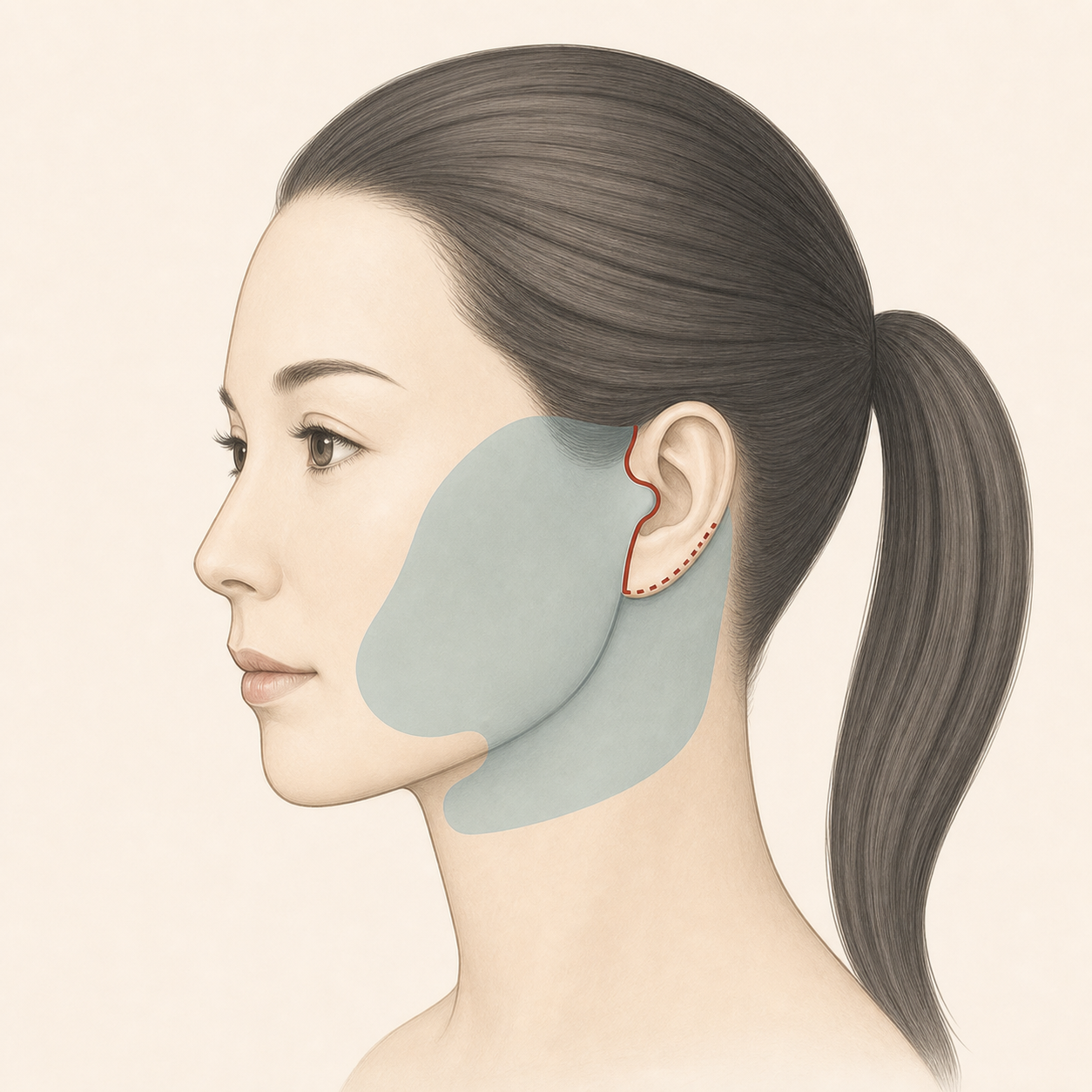
Forehead lift incision and area of dissection

Short-Incision Temporal Lift

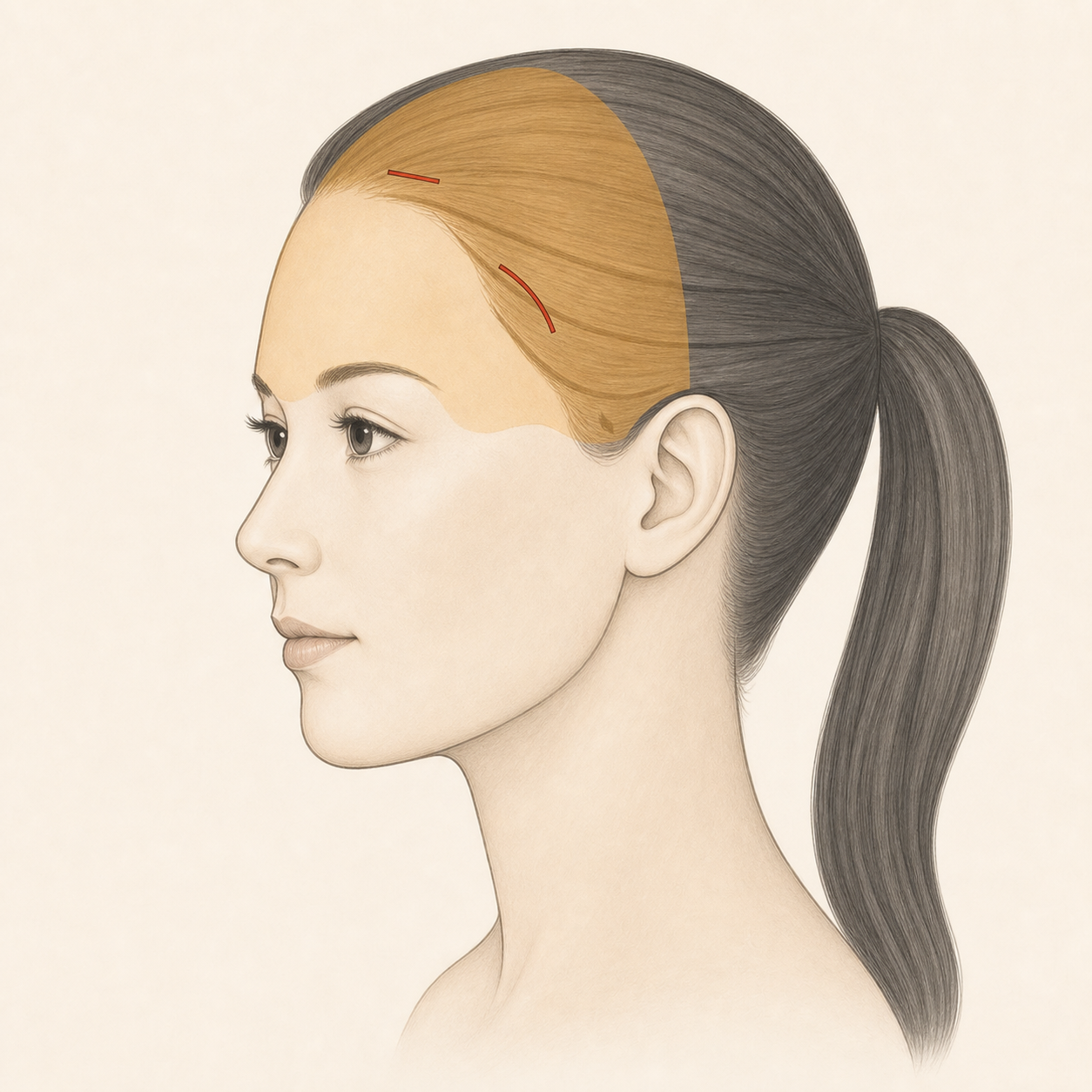
Through a short incision hidden in the hair, this procedure gently improves laxity around the outer eye. It may also be used to complement the effect of a facelift.

Principal risks: bleeding, infection, facial nerve injury or weakness, visible scarring, hair loss around the incision and asymmetry.

Red: incision line Blue: area of dissection
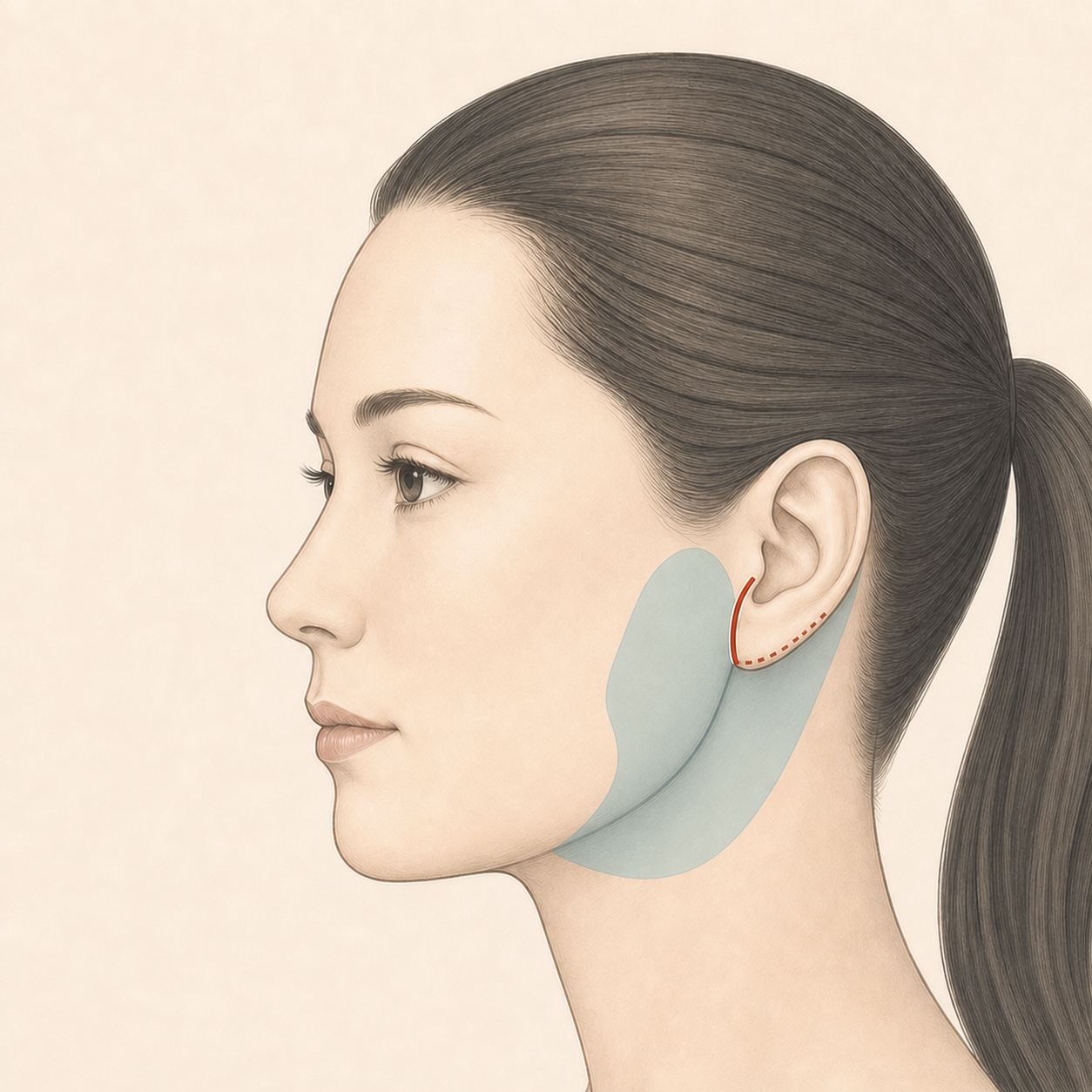
Short-incision temporal lift incision and area of dissection

Temporal Lift

By directly elevating the orbicularis oculi muscle, this procedure provides a stronger correction of outer-eye laxity and dynamic lines that appear when smiling.

Principal risks: bleeding, infection, facial nerve injury or weakness, visible scarring and asymmetry.

Red: incision line Blue: area of dissection
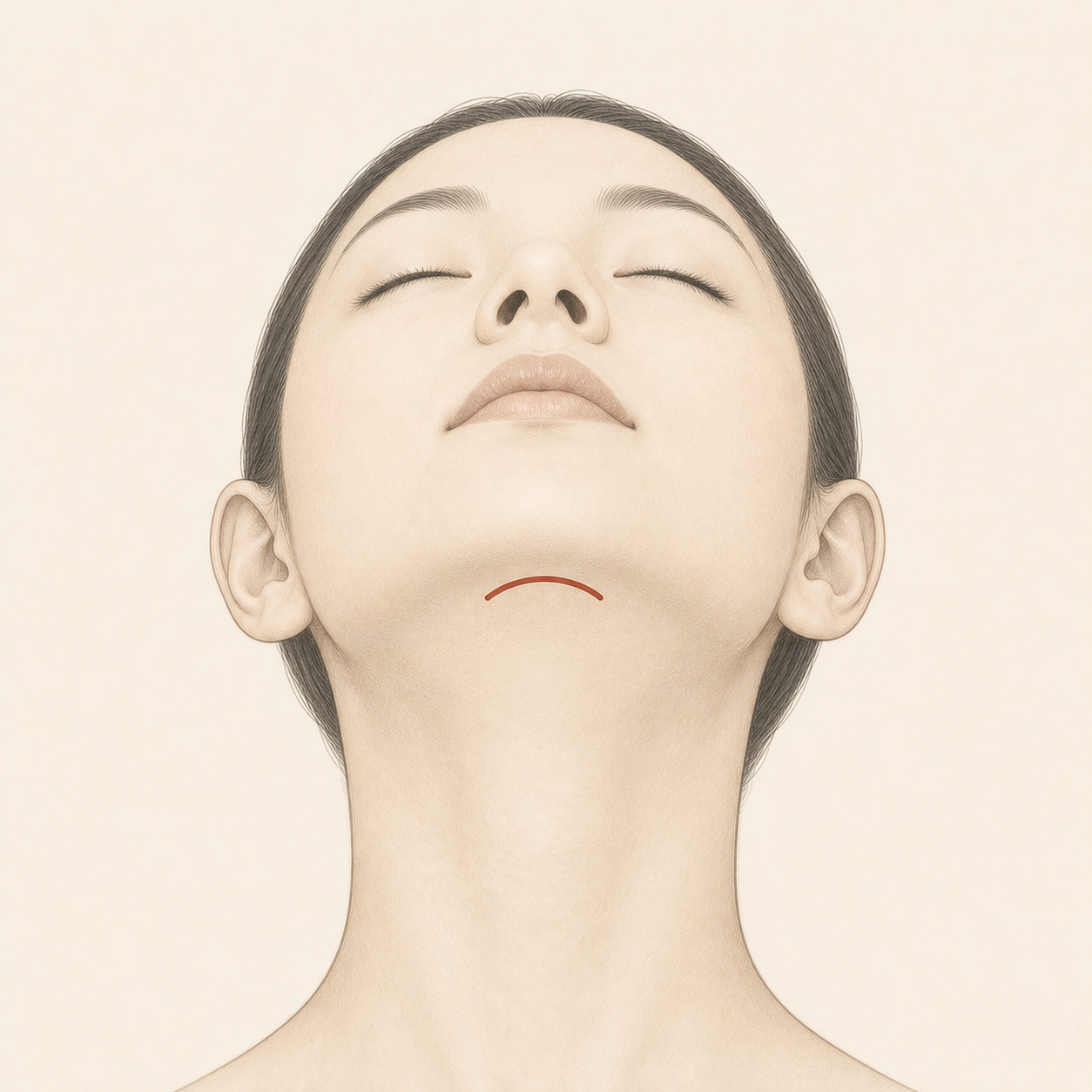
Temporal lift incision and area of dissection

Extended Temporal Lift

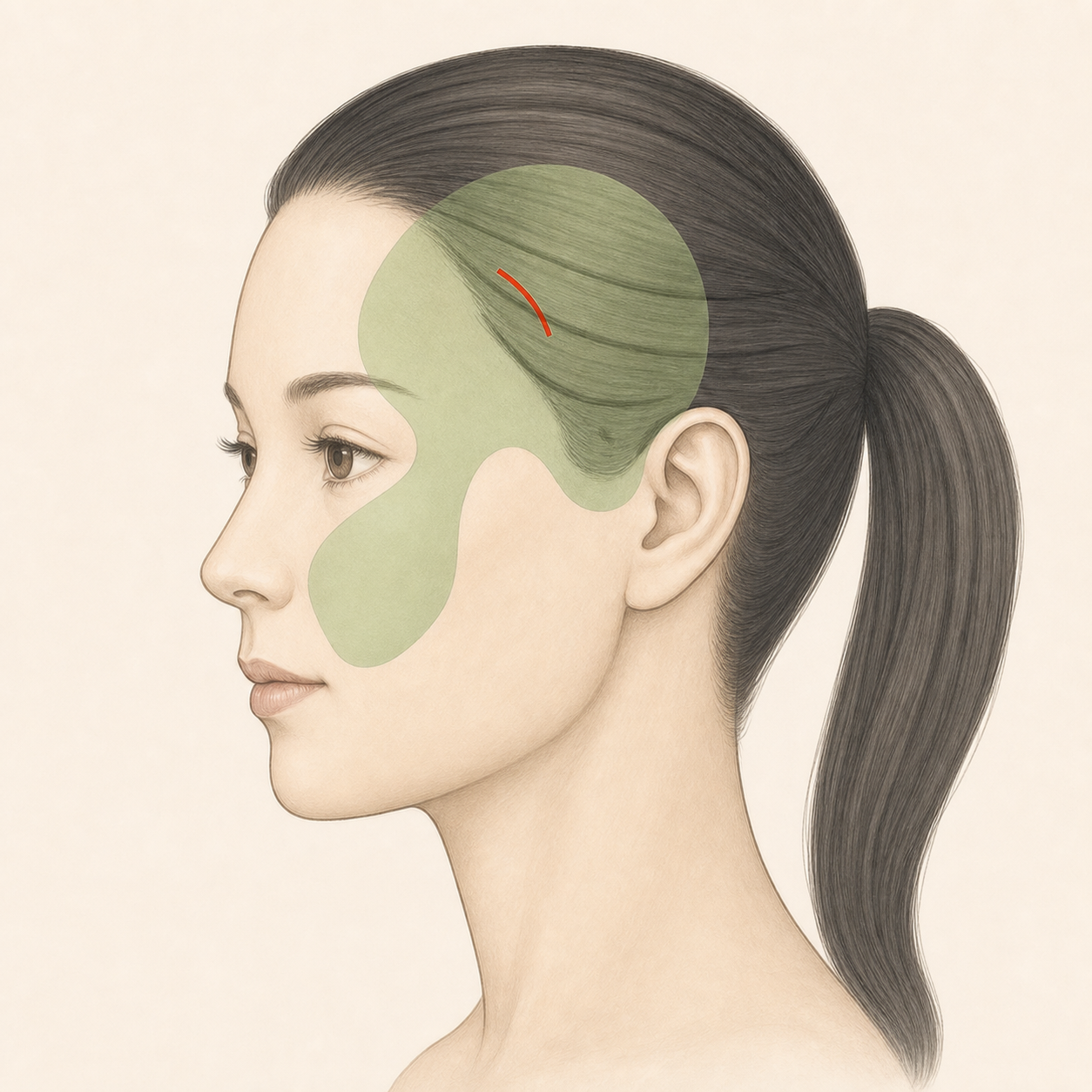
This procedure lifts a broader area extending from the outer eye into the midface. It is also known as a ponytail lift.

Principal risks: bleeding, infection, facial nerve injury or weakness, visible scarring and asymmetry.

Red: incision line Blue: area of dissection
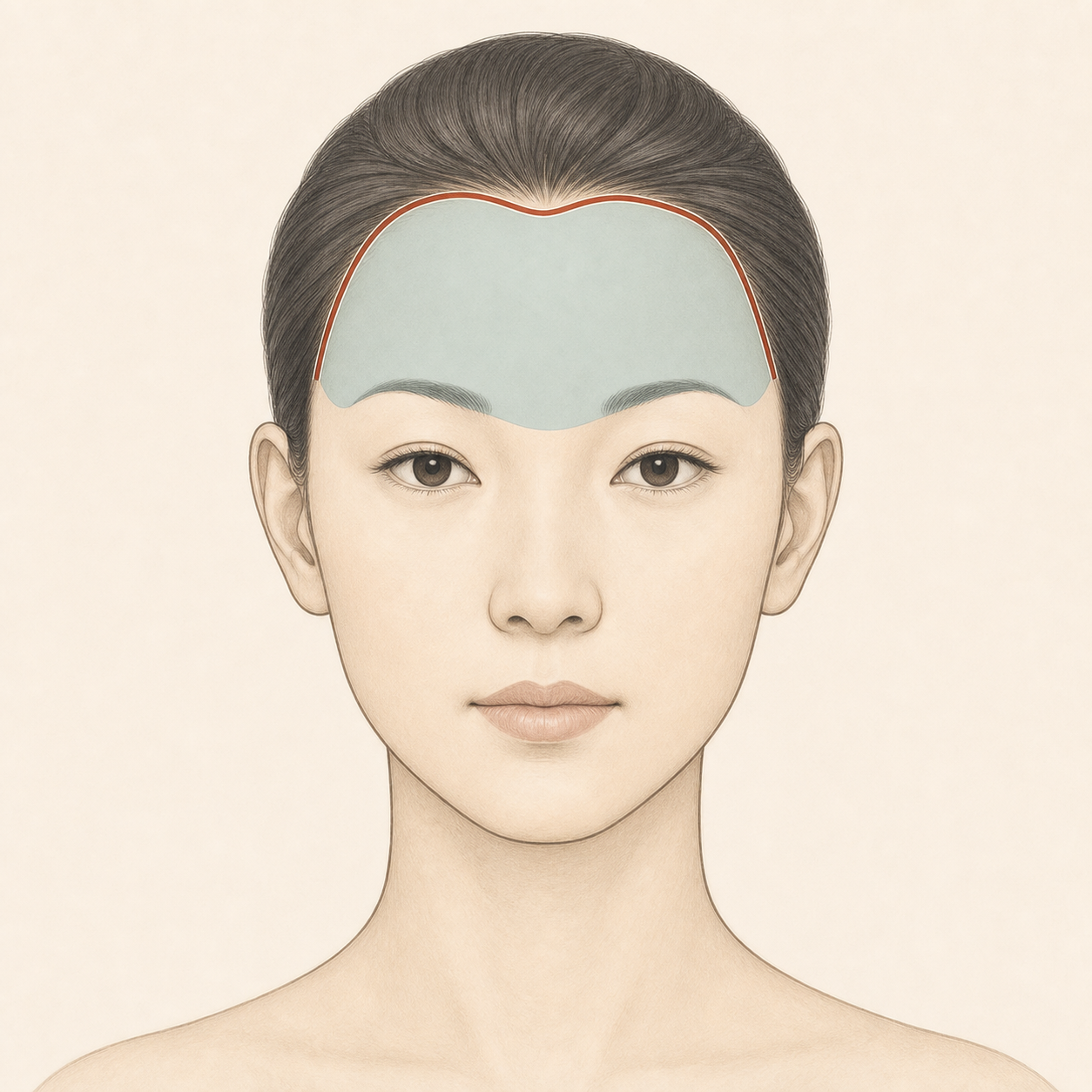
Extended temporal lift incision and area of dissection

Midface Lift

This procedure addresses lower-eyelid shadows caused by contour irregularity, midface descent, nasolabial folds and the tear-trough-to-cheek groove. The lower eyelid and cheek are treated as one continuous unit, with removal of fine lower-eyelid skin when indicated.

Principal risks: bleeding, infection, nerve injury, visible scarring, asymmetry and lower-eyelid ectropion.

Red: incision line Blue: area of dissection
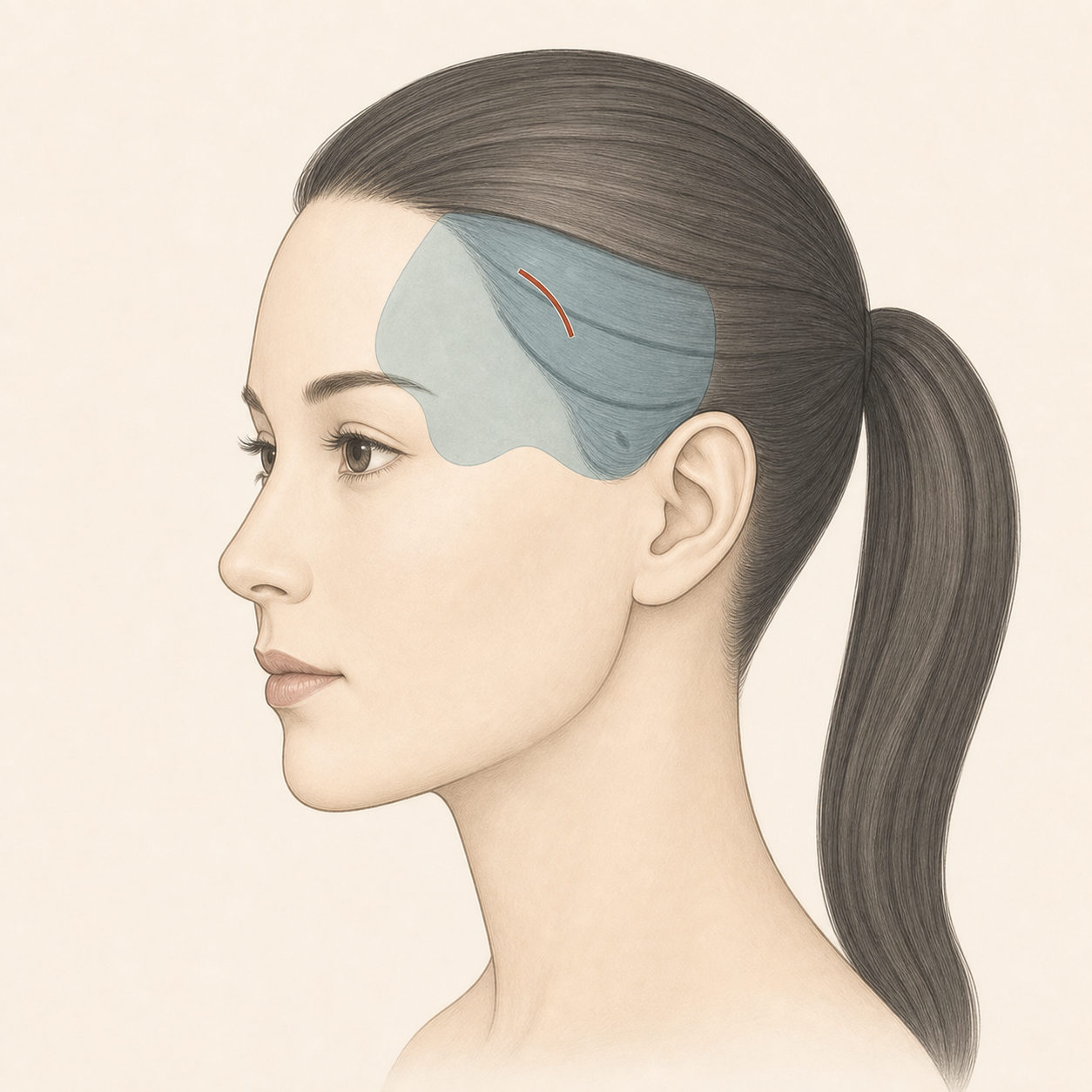
Midface lift incision and area of dissection

Transconjunctival Midface Lift

Approaching through the conjunctival side of the lower eyelid, this procedure addresses the inner lower-eyelid-to-midface region. It leaves no visible incision on the skin surface.

Principal risks: bleeding, infection, nerve injury, asymmetry and lower-eyelid entropion.

Blue: area of dissection
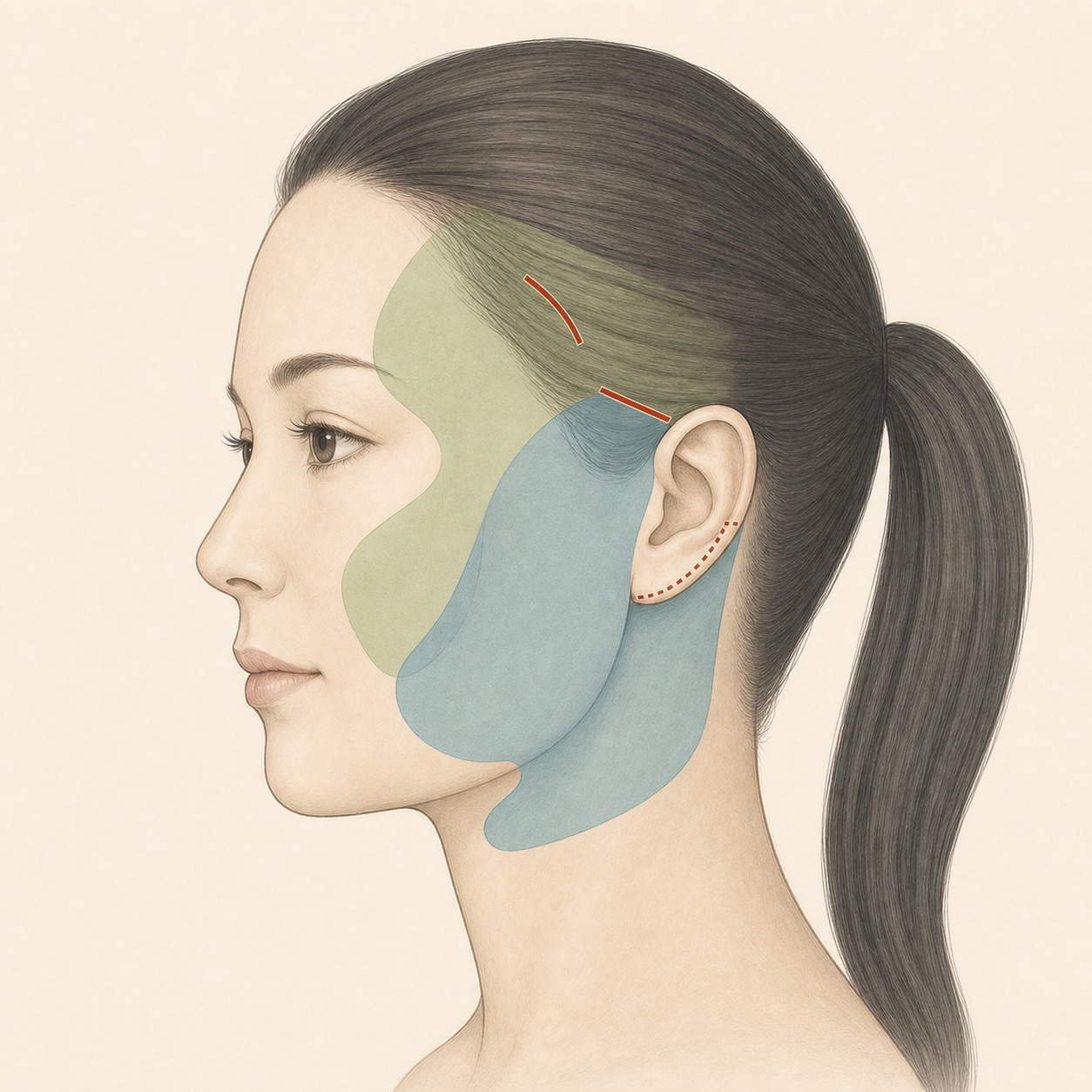
Area of dissection for a transconjunctival midface lift

04 — Endoscopic Lift

Endoscopic Lift

Using an endoscope, the intended tissue plane is released and secured through incisions concealed within the hair or behind the ear, depending on the treatment area.

Endoscopic Forehead Lift

This procedure improves laxity of the forehead, temple and outer eye, as well as brow descent, and includes the short-incision temporal lift. Lifting can be performed in the anatomical plane where laxity develops, allowing a natural elevation.

Principal risks: bleeding, infection, facial nerve injury or weakness, visible scarring, hair loss around the incision and asymmetry.

Endoscopic forehead lift surgical illustration

Endoscopic Extended Temporal Lift

This procedure uses an endoscope to lift the temple, outer eye and midface. It is also known as an endoscopic ponytail lift and may be suitable for patients concerned about laxity extending from the outer eye into the midface.

Principal risks: bleeding, infection, facial nerve injury or weakness, visible scarring, hair loss around the incision and asymmetry.

Endoscopic extended temporal lift surgical illustration

Endoscopic Face & Neck Lift

This procedure treats a continuous area from the temple through the midface and lower face to the lateral neck, with incisions concealed in the hair and behind the ear. It is most effective in patients with relatively mild laxity.

Principal risks: bleeding, infection, facial nerve injury or weakness, visible scarring, hair loss around the incision and asymmetry.

Endoscopic face and neck lift surgical illustration

Endoscopic V-Line Lift

This procedure uses an endoscope to improve the lower face and lateral neck, refining the jawline. It is intended for patients with relatively mild laxity.

Principal risks: bleeding, infection, facial nerve injury or weakness, visible scarring and asymmetry.

Endoscopic V-line lift surgical illustration

Endoscopic Lateral Neck Lift

Through an incision behind the ear, this procedure improves the lateral neck. When combined with submental treatment, it can address the neck more comprehensively.

Principal risks: bleeding, infection, facial nerve injury or weakness, visible scarring and asymmetry.

Endoscopic lateral neck lift surgical illustration

Consultation

Treatment Tailored to
Your Goals and Anatomy

Rather than choosing by procedure name alone, I examine the area of concern and the anatomical cause of change before recommending an individual treatment plan.