An effective facelift does not depend on pulling the skin as tightly as possible. It depends on treating the depth at which laxity is centered. The superficial musculoaponeurotic system—the SMAS—is essential to this discussion, but it is not a single membrane of identical thickness throughout the face.

What is the SMAS?
SMAS stands for superficial musculoaponeurotic system. It is often described as a fascial system located deep to the subcutaneous fat.
In reality, it is a composite structure involving fibrous tissue, fat, retaining ligaments and continuity with the muscles of facial expression. Its thickness and composition vary by region, so it cannot be reduced to a single, sharply bounded membrane.
Why skin alone is not enough
Skin stretches and is not well suited to supporting strong tension over a long period. If the lift relies excessively on the skin, tension may be transferred to the scar, the contour around the ear may change, and recurrence may occur earlier.
Modern facelifts therefore evaluate the deeper tissues, including the SMAS, and mobilize or fix them when required.
This does not mean that any operation touching the SMAS will automatically produce a good result. The surgeon must determine which tissues are being treated as SMAS, how far they are mobilized and in which direction they are fixed.
The five facial layers and the SMAS
The facial soft tissues can be understood in five layers from superficial to deep: skin, subcutaneous tissue, the SMAS and its continuous structures, facial spaces, and periosteum or deep fascia.
The SMAS occupies the third layer. It continues with the muscles of facial expression and supporting tissues in the face and with the platysma in the neck. Although it is not a uniform sheet, it is an important supporting layer that can be mobilized and fixed during facial surgery.
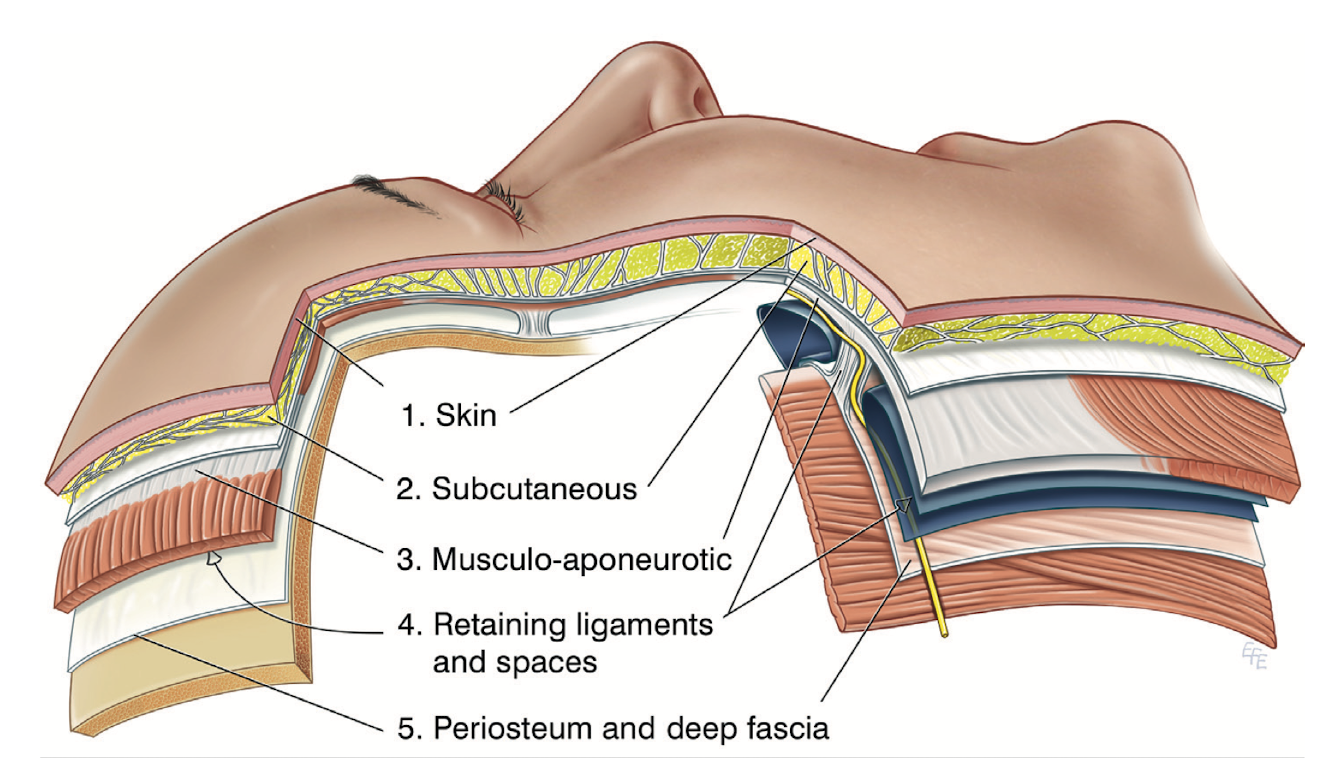
What does it mean when a paper says “the SMAS does not exist”?
A 2024 plastic surgery paper questioned whether the SMAS should be considered an independent, uniform anatomical structure.
This does not mean that deeper tissue treatment is unnecessary in facelift surgery. Rather, it suggests that the structure surgeons call the SMAS is a working composite of fibers, fat, muscle and ligaments instead of a single continuous membrane.
The debate over terminology should therefore be separated from the surgical need to manage the deeper tissues appropriately.
Questions more useful than the procedure name
During consultation, the following questions are more informative than the labels “SMAS technique” or “Deep Plane” alone.
- Which depth of tissue will be mobilized, and how will the SMAS be managed?
- How far will the fixed structures limiting correction be released?
- How will tension be distributed between the skin and the deeper tissues?
Two operations with the same name may differ in dissection and fixation. The label alone cannot determine the operation or the resulting change.
Summary
The SMAS is an important concept for understanding facelift surgery. Treating it as a simple, uniform membrane, however, can create a gap between terminology and actual anatomy.
The central goal is to avoid relying on the skin alone and to mobilize and fix the appropriate depth of tissue according to each patient’s anatomy and pattern of laxity.